
Radical Geek field note
Token Efficiency in the Age of LLMs: Languages, Compression, and the Art of Saying More With Less
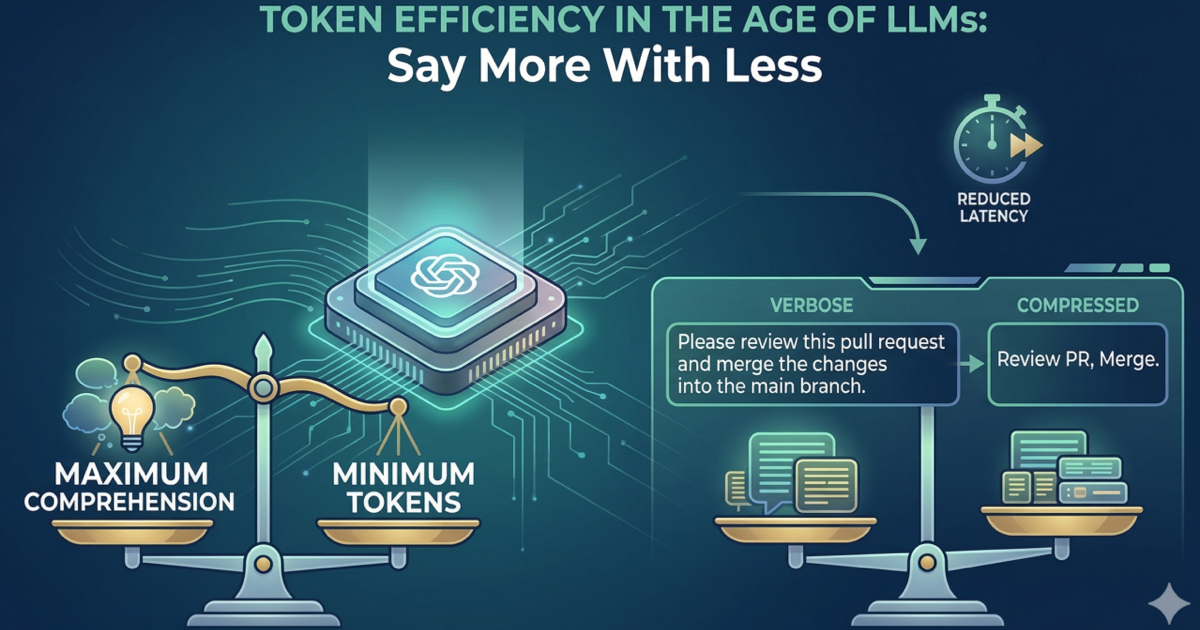
Token efficiency is not about saying less. It is about preserving meaning while reducing cost, latency, and context pressure.
Originally published on LinkedIn on 8 April 2026.
As large language models become central to software systems, tokens become an architectural constraint.
Tokens affect cost, latency, context limits, retrieval accuracy, and the practical shape of agentic workflows. The question is not simply “how do we use fewer tokens?” It is: how do we preserve meaning while reducing waste?
That distinction matters. Aggressive compression can save tokens and destroy comprehension. Natural language can be verbose, but that redundancy often helps the model triangulate intent.
Token Efficiency Is Semantic Density
Token efficiency is not the same as character count. It is semantic density per token.
A good representation:
- uses fewer tokens
- preserves meaning
- remains familiar to the model
- avoids ambiguity
- supports downstream reasoning
A bad one may look compact but force the model to guess.
Natural Languages Behave Differently
Different human languages carry meaning with different density.
English is flexible and well represented in training data, but often verbose. Chinese can be extremely compact because written characters carry dense conceptual meaning. Japanese blends concept-dense Kanji with phonetic scripts. German compresses ideas through compounding, though tokenisers may still split the words internally.
The practical lesson is not “use Chinese for everything”. Model familiarity matters. A less compact representation the model understands reliably may outperform an efficient one that introduces uncertainty.
Useful Compression Patterns
For engineering systems, the most practical gains come from disciplined compression:
- use standard abbreviations such as PR, CI, API, DB
- strip filler words when intent remains clear
- use structured formats for structured data
- prefer TSV or compact tables where JSON repeats keys unnecessarily
- compress repeated entities, not novel reasoning
- keep domain-specific shorthand consistent
The aim is minimum tokens for maximum clarity.
Compression Can Hurt
LLMs are not compression engines. They are pattern-completion systems.
They perform best when input resembles patterns they have seen before. If you invent a dense private dialect, you may reduce token count and increase error rate. If a human cannot scan it quickly, the model may struggle too.
Some redundancy is signal. It anchors meaning. Remove too much and the model has to infer intent from fragments.
Agentic Workflows Need Two Layers
The strongest pattern is a two-layer architecture:
- Keep rich, complete state outside the model.
- Send the model concise, task-specific context.
The local layer can hold full logs, files, memory, runbooks, and history. The LLM layer receives compressed summaries, relevant decisions, and structured task context.
That gives you the benefit of compression without impoverishing the underlying system.
The goal was never fewer tokens for their own sake. The goal is better thinking per token.